
Sinners in the Hands of . . . | A Sermon on Certainty and our Scandalously Merciful God
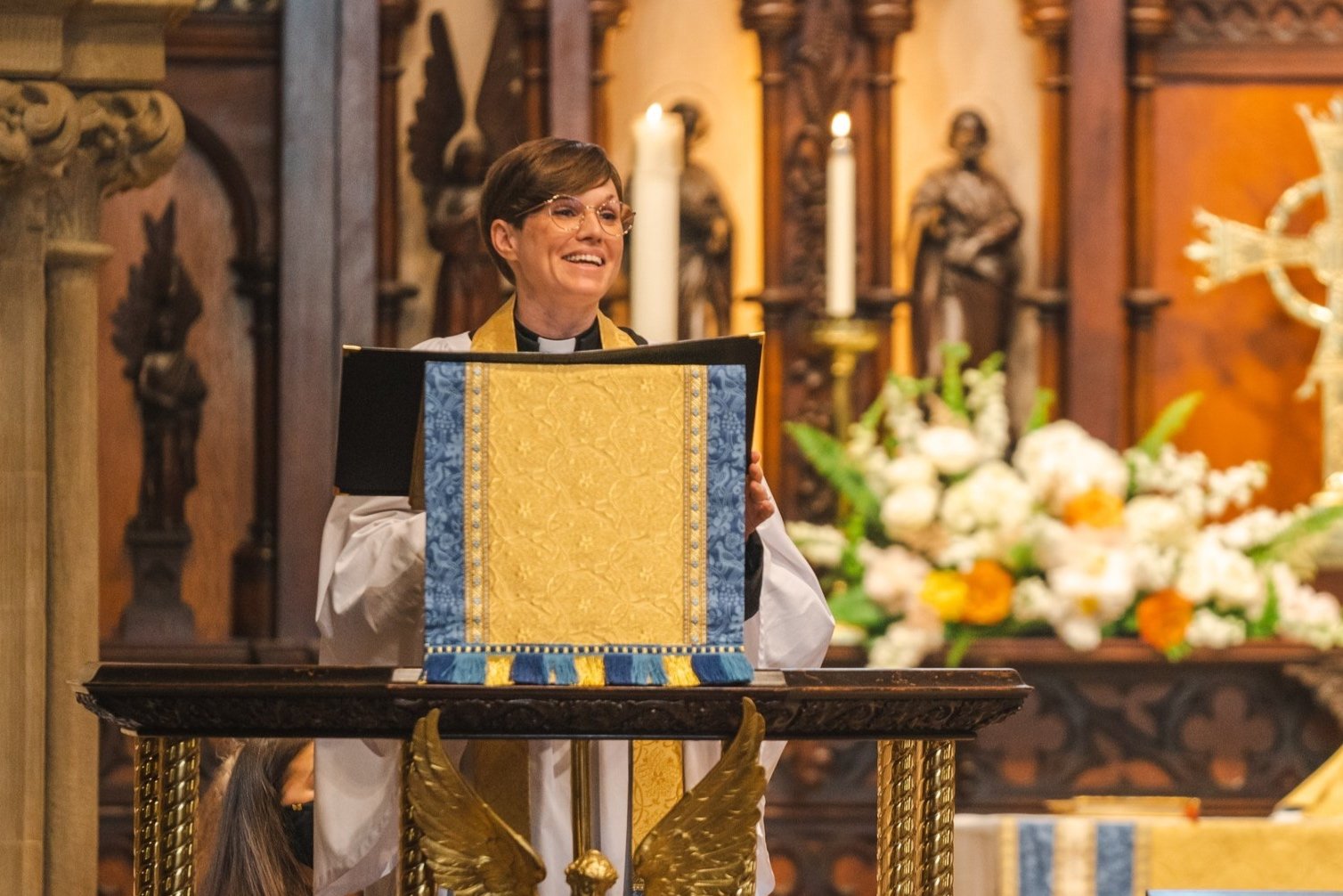
A Sermon by the Reverend Crystal Hardin on the Twelfth Sunday after Pentecost, August 16, 2026.
Matthew 15:21-28
At some point in elementary school, we were learning to write book reports and were asked to choose a short story or book. Naturally I chose an 18th century Puritan sermon about eternal damnation: Sinners in the Hands of an Angry God by Jonathan Edwards [1].
Of course, no one questioned the appropriateness of this - it was Alabama in the 90s?
I remember reading it for the first time and being completely transfixed. After the initial fear thawed, I’d read it again.
Had I known then that women could be clergy (or even that they could speak in church) I would have undoubtedly sensed my own call to ministry.
It was the language and imagery that drew me in and Edwards’ fervor and confidence that captivated me: “your wickedness makes you as it were heavy as lead . . . and if God should let you go, you would immediately sink and swiftly descend and plunge into the bottomless Gulf (of Hell).”
The drama served up as certainty.
I suppose I have always been drawn to religious language that makes me really uncomfortable. Not because I think discomfort is holy in itself. And certainly not because I agree with Jonathan Edwards about everything he thought God was doing with sinners. But I learned early that discomfort is fertile ground for the voice of God. And, frankly, that there are some religious texts you cannot make harmless without also making them less interesting.
This morning’s Gospel is one of them.
Have mercy on me, Lord, Son of David (Matt. 15:22).
This is the cry of a Canaanite mother. She has journeyed toward Jesus in desperation because her child is suffering. And she throws herself at the feet of Jesus.
Have mercy on me, Lord, Son of David.
But he did not answer her at all (Matt. 15:22-23).
Which is heartbreaking. And when he does speak, well, it’s hard to hear. He essentially says that he isn’t for her, he didn’t come for her, she is not within the purview of his mission.
And then calls this woman a dog.
It is not fair to take the children’s food and throw it to the dogs (Matt. 15:26).
There are few sentences in the gospels that Christians want more desperately to explain away, especially our ilk.
Interpretations of this sentence - this entire exchange - abound, of course, because it is unsettling. Attempts have been made to domesticate it, contain it, to frankly make it less embarrassing.
We are told that the Greek word may mean a household dog, a little dog, perhaps even a puppy (and we can imagine it a cute one at that) but I’m not sure this substantially improves the situation.
Needless to say, there are ways of interpreting this exchange that make it considerably less problematic.
And I’m not particularly interested in those this morning. Because sometimes our discomfort with the Bible is precisely where it has something to teach us.
On its face, this is a scene of Johnathon Edward’s level certainties.
The disciples are certain this woman is a nuisance, well outside their circle of care; the ethnic and religious categories of the day support that conclusion, clearly marking her as an outsider; Jesus himself articulates a particular mission that does not include her or her people, and he does so with certainty.
Last Sunday we talked about the things families hand down: patterns, wounds, stories, ways of loving and hurting one another. This week, we can see that we also inherit ways of dividing the world with lines drawn in the sand long before we arrived —lines marking who matters, who is us and who is them, who deserves access, who deserves to be believed, who should have a place at the table, and, most astonishingly, what we assume God thinks about it all. And we can do this with a generationally-laden certainty.
It is not fair to take the children’s food and throw it to the dogs.
And she said, “Yes, Lord, yet even the dogs eat the crumbs that fall from their master’s table.”
Even the dogs eat the crumbs that fall from their master’s table.
Just a few chapters earlier in this same Gospel, Jesus says one of my favorite lines of scripture: Go and learn what this means, ‘I desire mercy, not sacrifice.’ For I came not to call the righteous, but sinners.”
Go and learn what this means: I desire mercy (Matt. 9:13).
And here she is pleading, have mercy on me, Lord.
Such that in this moment, the Good News of Jesus Christ intersects with a particular claim on that Good News. A claim that the Good News should be and is truly Good News for everyone, even those to whom the world wants us to believe that we are diametrically opposed. Not our people. Not our way. Not our mission.
Have mercy on me.
a Canaanite, not of the house of Israel
a woman, with little status or protection
alone, no protector or representative, all propriety out the window
Desperate for what only Jesus can give.
Have mercy on me.
She is not in their image, and she demands to be seen. Sure, I’m not one of you. Not even close. Perhaps I am a dog, yet even the dogs eat the crumbs that fall from their masters’ table.
There are few sentences in the gospels not spoken by Jesus that get caught up and carried into our own liturgical tradition in a prominent way. This is one of them:
We are not worthy so much as to gather up the crumbs under Thy Table. But thou art the same Lord whose property is always to have mercy (BCP 337).
This from an optional prayer to be said before approaching the Lord’s Table during a Rite I, traditional language, Eucharist. It will shock exactly no one that this prayer is on my all times greatest hits list. And it will shock exactly no one that this prayer is, in my experience, one of the main reasons people do not use Rite I, even though its optional.
I can understand why. Especially after hearing the language Jesus uses with this mother.
And yet her response is not self-abasement; it is theological audacity. And don’t you love that? She is magnificently unwilling to accept that her identity places her outside of God’s mercy.
Where’s my Good News? She asks.
Where’s my place at the table?
Isn’t there enough to go around? I’m in desperate need of what only you can give.
And thou art the same Lord, whose property is always to have mercy (BCP, 337).
She looks at the table and sees a feast; one that will surely overflow because it is already overflowing. Sustenance right there, the abundance raining down like manna from heaven. Mercy spilling over as easily as crumbs to the floor.
She seems to be saying: surely God is not so small, the table not so limited, that healing me means depriving someone else.
She doesn’t ask Jesus to throw out the table; she doesn’t even dispute the metaphor; she discovered room inside it that everyone else has overlooked.
Even by your own metaphor, she seems to be saying, there is still room for me.
Rabbi Jonathan Sacks once said that “the supreme religious challenge is to see God’s image in one who is not in our image.”
And perhaps that is precisely the challenge unfolding here. Because then something changes: Woman, great is your faith! Let it be done for you as you wish (Matt. 15:28). And her daughter was healed instantly.
What exactly happened in this moment is unclear. You could go in a few faithful directions theologically and many of those directions would place this encounter well within Jesus’s hands and plans.
He probably knew where this encounter was going all along. He could have been testing her or his disciples. He could have been drawing out her faith for the audience’s edification. None of these are beyond the realm of possibility.
And yet there is another way to think about it. Perhaps something genuinely changed in the encounter. Perhaps this woman’s persistence, her clarity, her audacious trust in the wideness of God’s mercy, pressed against the shape Jesus had given his mission and enlarged it.
Begging the question: is this a story of revelation or a story of conversion?
Is Jesus revealing a mercy he already knows has no such limits, drawing the woman’s faith into the open for the sake of the disciples and everyone watching?
Or is Jesus himself changed by the encounter —converted, if we dare use that word —not from sin into righteousness (who do you take me for), but from one understanding of the scope of his mission into something larger, something more profound, something, frankly, more Jesus-like.
This second option sounds riskier for our Christology (our sense of the divinity of Jesus the Christ), but it is so much more interesting. And if interesting isn’t a fruit of the spirit (is it Kelly - no?) I’m claiming it as one today. And I confess that I find this reading most compelling, even with the questions it might raise.
We have a high Christology, and rightly so. Jesus is not simply a very wise teacher who occasionally gets things wrong and needs correcting. We proclaim Jesus as the Word made flesh, very God of very God.
And yet, the Church also insists, just as fiercely, that Jesus is fully human —not simply pretending to the be human. Not God wearing humanity as a costume.
Fully human.
And Scripture tells us that Jesus grew in wisdom (Lk. 2:52).
So perhaps learning is not a threat to the incarnation. Perhaps being changed by an encounter is not evidence against divinity. Perhaps it is evidence of a humanity fully inhabited.
Go and learn what this means: I desire mercy and not sacrifice. And Jesus went and Jesus learned from the Canaanite woman, not because Jesus is less than, but because she knows what mercy looks like from the side of the boundary that excludes her. Sometimes the people at the edge can see the wideness of grace more clearly than those standing comfortably at the center.
At the end of the day, I am less interested in proving exactly what changed inside Jesus than in noticing what unquestionably changes in the story. About this there is little doubt. The Canaanite woman may have been outside their circle of concern, but she has never been outside the sight of God. And what results is that:
A line that looked firm no longer holds; and an inherited division does not survive an encounter with Jesus.
And perhaps that is because the table was never actually threatened by her presence. There is no scarcity there. The woman asks only for crumbs, but the Gospel reveals something much bigger. Her healing does not take healing away from Israel. Her place does not displace anyone else. Her belonging does not diminish theirs.
God’s mercy is not a finite resource to be carefully rationed among those we have decided deserve it most. There is enough.
Enough mercy.
Enough grace.
Enough healing.
Enough God.
And yet so much of the way we divide the world assumes otherwise. If there is room for you, perhaps there will be less room for me. If your suffering demands attention, mine will be overlooked. If your story is believed, mine will somehow be diminished. If grace extends all the way to you —whoever you happen to be in the story I have inherited about the way the world works - then perhaps there will be less grace left over for me
But that is not how the table of God works.
Thou art the same Lord whose property is always to have mercy.
Always.
Not occasionally or selectively. Not for the right people asking or approaching in the right way.
Always.
And maybe this is where that old Prayer of Humble Access is less an exercise in groveling and more a declaration of abundance.
We are not worthy so much as to gather up the crumbs from under thy Table. True enough. Not one of us earns our place here. But the prayer does not end there. But thou art the same Lord whose property is always to have mercy.
In the words of today’s hymn [2]:
There’s a wideness in God’s mercy; like the wideness of the sea;
there’s a kindness in His justice; which is more than liberty.
There is grace enough for thousands; of new worlds as great as this;
There is room for fresh creations; in that upper home of bliss.
I think what really captivated me all those years ago about Jonathan Edward’s sermon was his certainty about where everyone stood before God. It was scary, but it was known. As my faith evolved, I came to believe quite strongly that Edward’s was, frankly, full of it —it seemed to me then that God makes it very difficult to remain quite so certain about anything. And now I find myself arriving at a very sweet spot where I could not be further from Edward’s theologically and yet I share a similar certainty about where God’s people stand before God.
Because from what I can tell, the point is not how low we can make ourselves before God. Even lowness is a way of earning, and God does not deal in that business.
The point is, has always been, and will always be who God is: merciful, abundant, and the host of a table where even the crumbs contain more grace than we can ever know what to do with.
My friends, we are sinners in the hands of a scandalously merciful God who refuses to ration love. And thanks be to God for that.
If our love were but more simple; We should take Him at his word;
And our lives would be all sunshine; In the sweetness of our Lord.
Amen.
[1] The Works of Jonathan Edwards, Vol. 22: Sermons and Discourses, 1739–1742, ed. Harry S. Stout and Nathan O. Hatch (Yale University Press, 2003).
[2] Frederick William Faber, "There's a Wideness in God's Mercy" (1854).
