Time as Gift | A Sermon for Trinity Sunday
A Sermon by the Reverend Crystal Hardin for the First Sunday after Pentecost: Trinity Sunday (A), May 31, 2026.
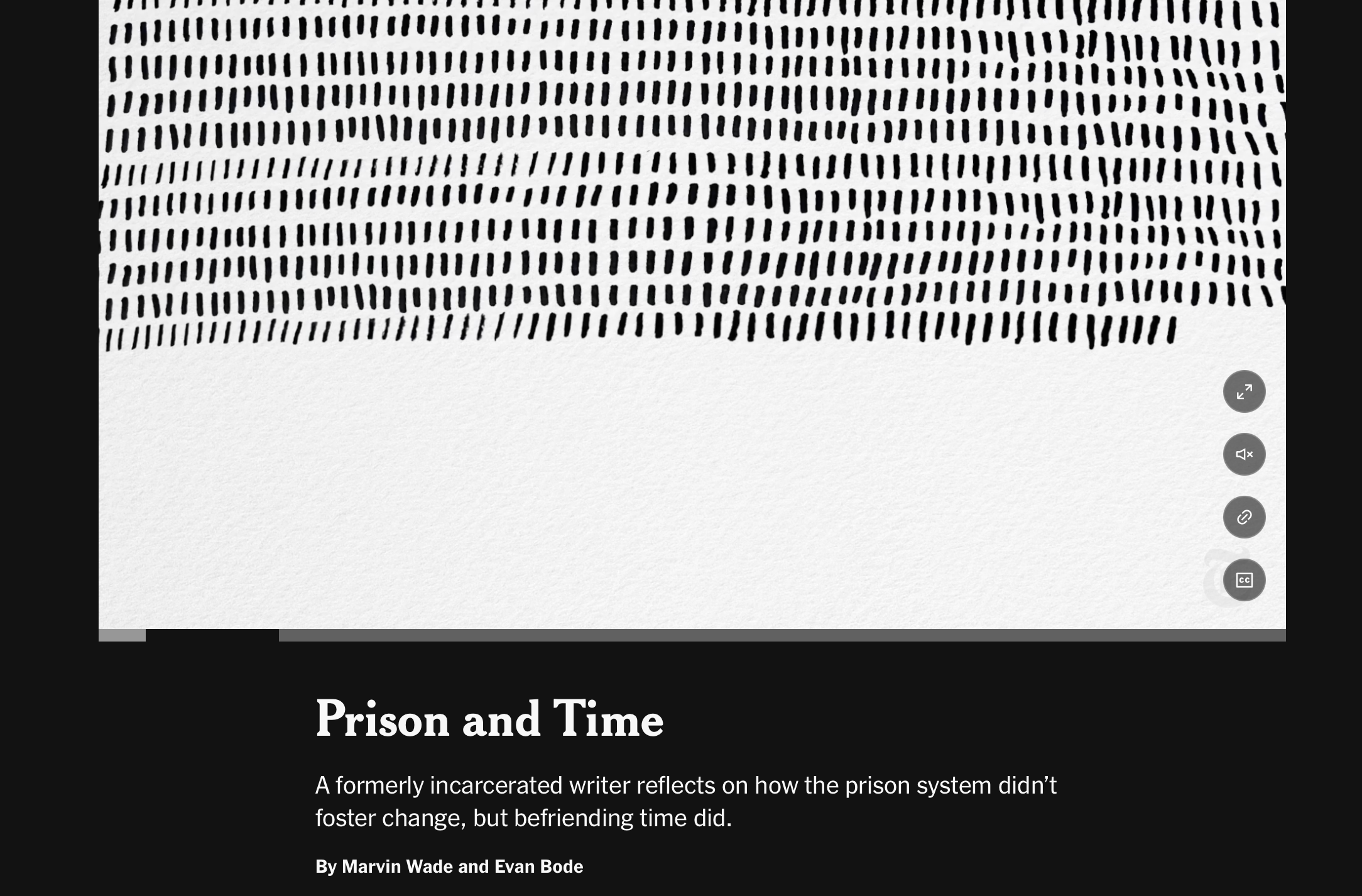
“Time is your friend. Controlled by no one. Therefore you to do within it as you please. It’s the space within a place. Any place.
For 25 years, prison was the place where time for me held space.”
These words are from a short film titled “Prison and Time,” [1] which melds expressive animations with personal testimony of incarceration. It explores how time itself can nurture growth and even offer a kind of freedom, despite extremely adverse circumstances. The film is a striking and thought-provoking offering (you can find it on the NYTimes website if you’re interested) and its reflections on befriending time have been with me all week.
We often talk about time as if it is something we own or use.
We save time. We spend time. We make time. We waste time. And we kill time - which is a rather alarming and ill-fitting phrase for moments when we are just hanging lose if you will. But whatever.
Most of us live with time as a kind of pressure. There is never enough or there is too much. It moves too quickly when things are good and too slowly when we they are not. It stretches endlessly in grief. It speeds up around deadlines and slows down in hospital rooms.
It gets counted in school years, fiscal years, liturgical years, election years, even dog years. It is tracked in prison terms, birthdays, chemo cycles, pregnancy trimesters, school years, and all the ordinary Tuesdays that somehow make up a life.
This morning we hear those first words from Genesis that place all our valuations of time in stark relief.
In the beginning when God created the heavens and the earth.
Before there is hurry, before there is delay, before calendars or countdowns or clocks or the concept of wasted time - there is God.
God who sets about making time.
Evening and morning, the first day.
Lights in the dome of the sky for signs and seasons and for days and years.
And finally, at week’s end, there is a time of rest.
Which means that, in the beginning, time is not punishment, prison, or productivity tool. Time is not something to optimize, monetize, fear, or conquer.
Time is simply Gift.
Made by God.
Blessed by God.
Given to creation in goodness.
Which may be one of the harder things for us to believe, given the way we encounter talk of time in our daily lives. Gift or curse. Too much or too little. Good time or bad.
We tend to see time in binaries. Time is either well spent or wasted. A life is either on schedule or behind. A season is either blessed or broken.
But as Rishabh so beautifully reminded us a few Sundays ago, God does not limit God’s self to the binary. In fact, I would go so far as to say that a strictly binary view of life is a misunderstanding of God’s very heart.
Genesis gives us something richer than a binary. Genesis gives us a view of time that is not one thing, but many. Evening and morning and dusk and dawn. That moment when the sky just starts to lighten and the birds just begin to sing and the stars just begin to fade from our view.
Time is textured. Time is spacious. Time is held by God. Not a thing to measure, but a gift to inhabit.
Of course, there are people for whom time is not spacious or blessed but confined. People for whom to see time as a curse would be reasonable.
The short film I referenced earlier makes this visible in a way that is hard to unsee. In prison, time is counted, controlled, surveilled, and imposed. It is measured not by seasons and sabbath but by sentence and release date, by years taken and years endured.
My children, when they were little, thinking it hilarious would spontaneously ask people: Guess which one of my parents have been in jail? And more than once?! After the awkwardness, people would usually guess me, but for the wrong reasons. I like to think this means I am potentially spontaneous and fun and down for an adventure that might end in the slammer. But no. Years before I became a priest, I was an attorney. And my focus was death penalty defense work. So I went in and out of jails and prisons somewhat regularly for a little while.
So, ha ha. It is true that my children do have one parent who has been in a jail multiple times.
In doing this work that I loved so much, I saw the way time was weaponized and monetized on the backs of the most vulnerable. And I saw my role, in many ways, as trying to give the gift of time. Of days and months and years of life, not death, to make of what they would.
That is often not the way my clients saw it, and I can’t blame them. At 17 years old, you aren’t prepared to see life in prison as a gift (even where the alternative is a death sentence).
So, there is such a thing as stolen time, punished time, and wasted by injustice time that must be recognized. In the short film, a formerly incarcerated writer shares what time allowed him to do, despite what prison tried to take away from him.
Genesis says time is good. It does not say time is easy. That it cannot be distorted, delayed, or that we cannot suffer inside it.
And yet, every now and then, there is a moment that reminds us that delayed time is not always lost time.
This month, an 88 year old retired Army Colonel named Kenneth Grundborg finally walked across the graduation stage at Georgia Tech. He had earned his undergraduate degree in 1960, but the Army sent him to Ft. Belvoir and then Korea before he could attend commencement. He earned his master’s degree in 1966, and then the Army sent him to Vietnam. So he missed that ceremony too. Sixty years passed. A whole life passed. Korea. Vietnam. Panama. Germany. Years of work, of memory, of ordinary life. And then, at 88 years old, wearing cap and gown and walking with proudly -head high, cane out front - he walked across the stage at Georgia Tech, receiving his diploma.
I’ve known Ken personally for over a decade now- he is a member of St. George’s, Arlington, the parish that sent me to seminary. And so I played the video on repeat this week. It is one of the more beautiful things I have seen in my life. But the way this story was picked up and shared by so many (it was on ABC news!) suggests to me that it was not my knowing Ken that got me. It was the sacramentality of the moment, of a life.
Sometimes grace gathers up what we thought was gone. Sometimes joy arrives late and is still joy. Sometimes the blessing does not come when it was supposed to come, but when it comes, it is no less real.
That, I think, is where Genesis and Matthew meet.
Genesis tells us that time belongs to God.
Matthew tells us that God has entered time and will not abandon us there.
Remember, I am with you always, to the end of the age.
In the beginning - in the evening - in the morning - in the waiting - in the wasting - in the grief - in the joy delayed sixty years, in the years that cannot be returned. In the age that is passing away and in the kingdom that is coming near.
Remember, I am with you always, to the end of the age.
We are not meant to master time. Although Lord knows most of us have tried.
Instead, we are to receive time as a gift. To hallow some with rest. To tell the truth about the way it is stolen from our neighbors. To resist a world that turns every hour into a commodity. To bless delayed joys when they come. To grieve lost years without pretending they do not matter. To trust that no season of our lives is beyond the reach of God’s redeeming presence.
Because the promise of the Gospel is not that we will have all the time we want. It’s better than that. The promise is that our time for all time belongs to God.
We sometimes say that time is a thief. And we know what we mean.
Time steals childhood. Time steals strength. Time steals people we love. Time steals the future we thought we had. Time steals the version of ourselves we imagined we would become. Time steals the moment before we realize it was the moment.
And yet, Genesis dares to tell us that time is not first a thief.
Time is first a gift.
What steals from us is not time itself, but sin. Injustice. Violence. Neglect. Death. The powers and principalities. The illusion that our worth is measured by what we produce. The lie that some people’s time matters more than others. The cruelty that can take a human life and reduce it to a sentence, a number, a file, a wait.
Time is not the thief. Time is the place where the thief does damage.
And time is also the place where God does redemption.
Not always by giving the years back. That is the hard truth. Some years are gone. Some moments cannot be recovered. Some losses cannot be made untrue by even the most faithful theology.
But God redeems time not by pretending it did not hurt, and not by insisting that everything happens for a reason, which is one of those phrases I would happily launch into the sun if I could.
God redeems time by entering it.
The eternal Word becomes flesh. The Creator enters creation. The One who is before all ages becomes a child who has to be fed, and bathed, and taught to walk. Jesus grows. Jesus waits. Jesus weeps. Jesus spends thirty hidden years before three public ones, which is a deeply inconvenient ratio for those of us who prefer efficiency.
And then, at the end, Jesus gives his friends not a strategy for mastering time, but a promise for living inside it:
Remember, I am with you always, to the end of the age.
Always.
Which means our time is tender because Christ is in it.
Not only the useful time.
Not only the holy-looking time.
Not only the time we can explain afterward.
Christ is present in the time that feels wasted.
The time that feels delayed, stolen, ordinary, and almost too beautiful to bear.
This is, in part, why we keep coming back here, to church.
Week after week, year after year, season after season, we spend our time together as church. Which is a strange thing to do, honestly. There are certainly more efficient ways to spend a Sunday morning. There are errands to run and emails to answer and games to get to and laundry sitting somewhere in our homes quietly judging us.
And yet, here we are.
We come here to let God re-teach us what time is for.
Not for achievement only.
consumption only.
productivity only.
Not even for ourselves only.
Time is for communion.
For praise. For rest. For repentance. For showing up beside one another when the joy comes late and when the grief comes early. For holding babies and burying saints. For teaching children the songs some of us have been singing for eighty years. For making sandwiches, saying prayers, pouring coffee, forgiving badly, trying again, and learning, over and over, that our lives are not solitary possessions but gifts entrusted to one another for a time.
The church is not always good at this. We waste time too. We get anxious and petty and distracted. We hold too tightly to the past or rush too quickly toward the next thing. We confuse busyness with faithfulness, which is very easy to do.
But at our best, the church is a community that practices redeemed time.
A community that says: your time matters. As does your grief, your waiting, your delayed joy, your unfinished life.
And not because you have mastered it. (Thank God for that) But because Christ is with you in it.
So keep on coming to church, my friends.
And bring your rushed time.
Your wasted time.
Your stolen time.
Your waiting time.
Bring your ordinary, unfinished, beautiful, fragile life that has been given to you for a time and that God has called GOOD.
And remember that: Christ is with us, always, to the end of the age.
Amen.
[1] https://www.nytimes.com/video/opinion/100000010910796/prison-and-time.html?searchResultPosition=2.