Psalm 23 | A Sermon on a Cultural Icon
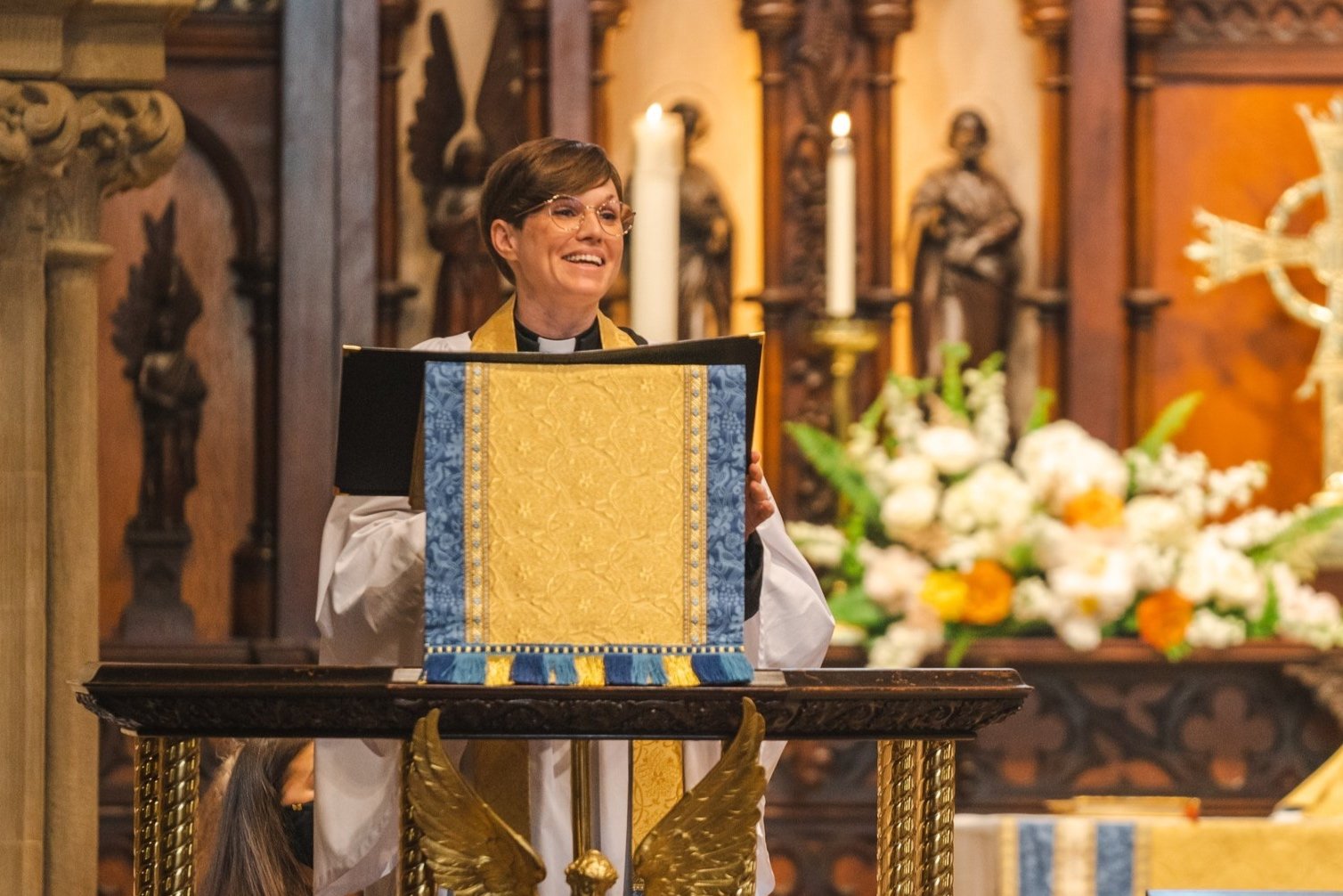
A Sermon by the Reverend Mother Crystal Hardin for the Fourth Sunday in Lent, March 15, 2026.
Bach. Duke Ellington. Coolio. The Grateful Dead. Pink Floyd. Bernstein. Eminem. Megadeth.
Believe it or not, all have something in common, beyond music of course. All have alluded to psalm 23 in their work, as have many others. It has shown up in various books and movies. You can find psalm 23 stitched on a pillow or printed on the side of a tervis tumbler.
As it turns out, the 23rd psalm is sort of a cultural icon.
Which is somewhat unfortunate. Because there are some lines of scripture that become so beloved, so familiar, so woven into the fabric of our lives that we almost stop hearing them. This psalm is at risk.
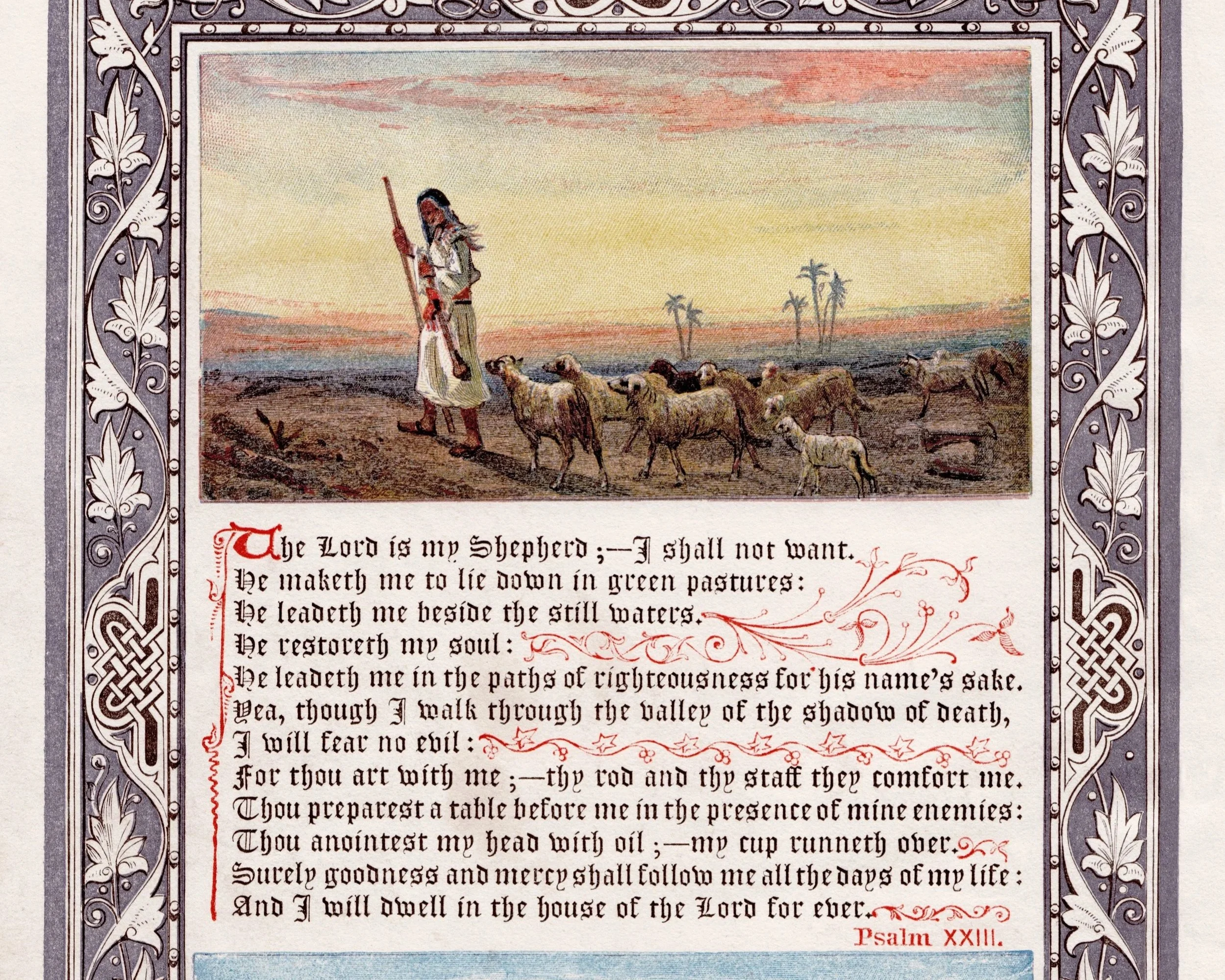
The Lord is my shepherd. I shall not want.
He maketh me to lie down in green pastures:
he leadeth me beside still waters.
Just as it may surprise you to learn that 1 Corinthians 13 was not in fact written for weddings, it may be news to you that the twenty-third psalm was not actually composed for funerals.
Yea, though I walk through the valley of the shadow of death, I will fear no evil.
Yea, though I walk through the valley of the shadow of death.
Not death itself, but moments that feel close enough to cast death’s shadow over a life.
A frightening diagnosis. A natural disaster. An addiction. The slow diminishment of dementia. A child’s mental health crisis. Profound loneliness. The collapse of a marriage. You get the idea.
Moments where your stomach drops out and the future does not look like one you want to step into. When the next faithful step feels like walking the plank.
Psalm 23, for all its beauty and familiarity, is not naïve. It meets us in the depths. It does not say there is no valley. It does not say there is no grief, no fear, no bewilderment, no want. It says that none of those things gets the final word. The Lord is my shepherd does not mean I never want, never fear, never grieve. It means my fear is not final, my lack is not ultimate, and my darkness is not unattended.
Because the 23rd psalm is a psalm for peril. A psalm for people with their backs against the wall. A psalm for desolate valleys, not just green pastures. Which is why it often shows up most meaningfully in the whispered prayers of people who cannot remember much else. In hospital rooms, by bedsides, in foxholes, on battlefields.
There is a Clint Eastwood classic movie where impoverished prospectors form a small community that is later attacked by horseman working for a wealthy landowner. In the attack, a child’s dog is killed.
Burying her beloved dog, the child, Megan, recites a slightly annotated version of Psalm 23.
The Lord is my shepherd, I shall not want . . . But I do want.
He leads me beside still waters . . . But they killed my dog.
I will fear no evil . . . But I am afraid. We need a miracle.
I will dwell in the house of the Lord forever . . . If you exist. But I want to experience this life first. But if you don’t help, we’re all going to die. Please help? Amen.
Honestly, that may be one of the most faithful renderings of Psalm 23 I have ever heard. Megan reminds us that Psalm 23 is, at its roots, prayer. A prayer by us and for us, a prayer that joins a great cloud of witnesses –those who came before us and those who surround us now. All the psalms are an invitation to pray, just as they are an invitation to sing.
Psalm 23 is a cultural icon, because it is a doorway into large and profound truths about the nature of the human condition and the nature of God in relation to it.
The Lord is my shepherd.
Samuel Wells notes that the Bible repeatedly portrays the people of God as beleaguered, under threat, oppressed, near despair. Again and again, we are given the image of sheep in danger and God as the shepherd who is with them despite it all.
That, I think, is exactly where this morning’s Gospel meets us. Because as soon as Jesus and the disciples encounter the man born blind, the disciples do what human beings so often do when they come upon suffering: they begin seeking neat answers and clear explanations.
“Rabbi, who sinned, this man or his parents, that he was born blind?”
It is such a human question. Who caused this? Whose fault is it? How did we get here? What is the explanation that will let me feel safe again?
We want suffering explained and blame assigned.
If someone is sick, perhaps they made bad choices. If someone is poor, perhaps they did not work hard enough. If someone is lonely, perhaps they brought it on themselves. If something terrible has happened to us, perhaps we missed a sign, failed a test, disappointed God, or wandered one step too far from the path.
We do this all the time, sometimes out loud, more often in our heads, because we are trying to protect ourselves from the terror of vulnerability. If I can explain your suffering, then maybe I can imagine avoiding it myself.
But Jesus will have none of it. “Neither this man nor his parents sinned,” he says. In other words: you are asking the wrong questions. The disciples treat the man not as a person, but as an object lesson, a proof text for their theology. But Jesus refuses that move. For Jesus, blame is not the point. Mercy is.
And that is worth pausing over. Because the man we encounter in John’s Gospel spends most of the chapter being discussed by people who do not really see him. The disciples theorize about him. The neighbors argue about him. The religious authorities interrogate him. Even his parents, understandably frightened, keep some distance from him. Everybody has a take, and very few people have tenderness. Everybody wants to explain him, and almost no one wants simply to see him.
Until Jesus does.
Jesus does not begin by trying to calm or comfort the bystanders. Jesus begins by turning toward the man himself.
For thou art with me.
That tiny word in Psalm 23 — with — is doing an astonishing amount of work. Not, thou hast explained everything to me. Not, thou hast removed every shadow from my path. Not, thou hast made me impervious to sorrow. Thou art with me.
That is the heart of the psalm.
That is the heart of the Gospel.
That is the heart of God.
For thou preparest a table before me in the presence of mine enemies.
In times of unrest, you are with me.
At the table, you are with me.
In the mess and in the mud you are with me.
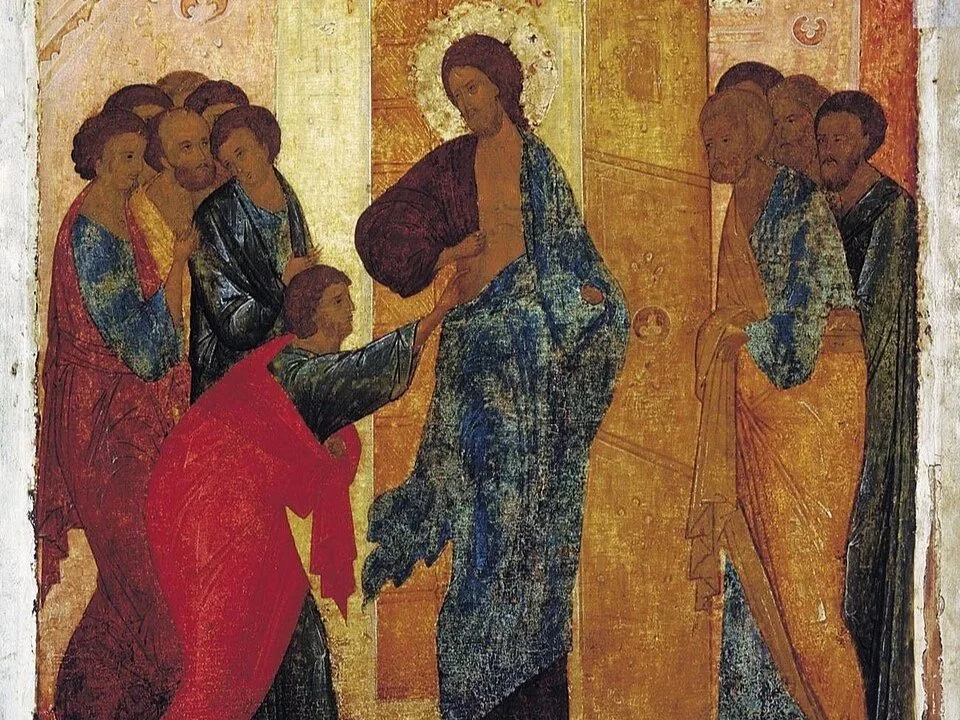
Jesus heals the man born blind in a way that is, frankly, a little strange. He spits on the ground, makes mud, and smears it on the man’s eyes. It is earthy. Material. A little unsettling. Sacramental and definitely on brand for Jesus.
He smears mud on the man’s eyes and then sends him to wash. To water. And we are told: Then he went and washed and came back able to see.
Just as in baptism, we are given new sight; washed not into easy answers, but into the life of Christ who has placed his hands upon us and claimed us as his own.
Because God, in Christ, does not save us from a safe distance. God uses matter: dust, saliva, water, bread, wine, human bodies, human touch. Creation itself becomes the means of our salvation and communion with God our deepest reflex.
The whole thing is terribly undignified, but isn’t that often the way of grace?
God grants us new sight, and yet it does not always arrive as clarity first. Sometimes things get muddier before they become clear. So if your prayer sounds less like polished piety and more like, “But I do want. But I am afraid. But I am tired. But I do not understand,” be not afraid. That is not the end of faith. It may just be where faith begins.
Because the opposite of faith is not doubt. The opposite of faith is the illusion that we already see just fine. And that, of course, is where John lands its hardest blow. The man born blind comes to see more and more clearly, while the ones most confident in their vision become more and more blind. “Surely we are not blind, are we?” the Pharisees ask.
It is a dangerous thing to be too certain of your own sight — dangerous in religion, politics, relationships, and even in the church. Because when we are too sure we see clearly, we stop asking questions. We stop looking deeper. And we most certainly stop expecting Jesus to surprise us.
Jesus said to them, “If you were blind, you would not have sin. But now that you say, ‘We see,’ your sin remains.”
This Gospel is not only about one man’s blindness. Perhaps it is not about his blindness at all. Perhaps it is about ours. About the blindness that makes us quicker to diagnose than accompany, quicker to explain suffering than relieve it, and more interested in causes than compassion — the blindness that lets us miss Christ standing right in front of us in the face of another human being.
Psalm 23 pushes against this blindness, because Psalm 23 reminds us who we are. We are not experts managing life from a position of control. We are sheep. Which is both humbling and, frankly, a little rude. Not majestic stallions. Not even golden retrievers. Sheep. Needy, wandering, vulnerable creatures, dependent on the care of another. Sometimes stinky.
And yet that is precisely the good news. Because if we are sheep, then our hope does not rest on our own brilliance or skill. It rests on the character and care of the shepherd.
And that is the deepest mercy of all. Because as Psalm 23 reflects, the One who knows us fully does not pass us by. For thou art with me.
Such a small, yet incredibly consequential word: with. Thou art with me. There is no place we will go — in head, heart, or body — where God will not follow. We are meant, in the deepest and truest sense, to dwell in the house of the Lord forever.
That does not mean we never want, never fear, never grieve. It means our fear is not final, our lack is not ultimate, and our darkness is not unattended. And because that is true, we can walk through any valley.
And we can remember there that we have, by God’s grace, been named, claimed, and washed into a love stronger than fear.
With God’s help, may we yet discover that behind the trials and sorrows of life, there are still waters calling us home — not just when we die, but as we live, each and every day. By grace, may we come to see that goodness and mercy have been following us all along.
Amen.