Thomas, the Twin | A Sermon for Low Sunday
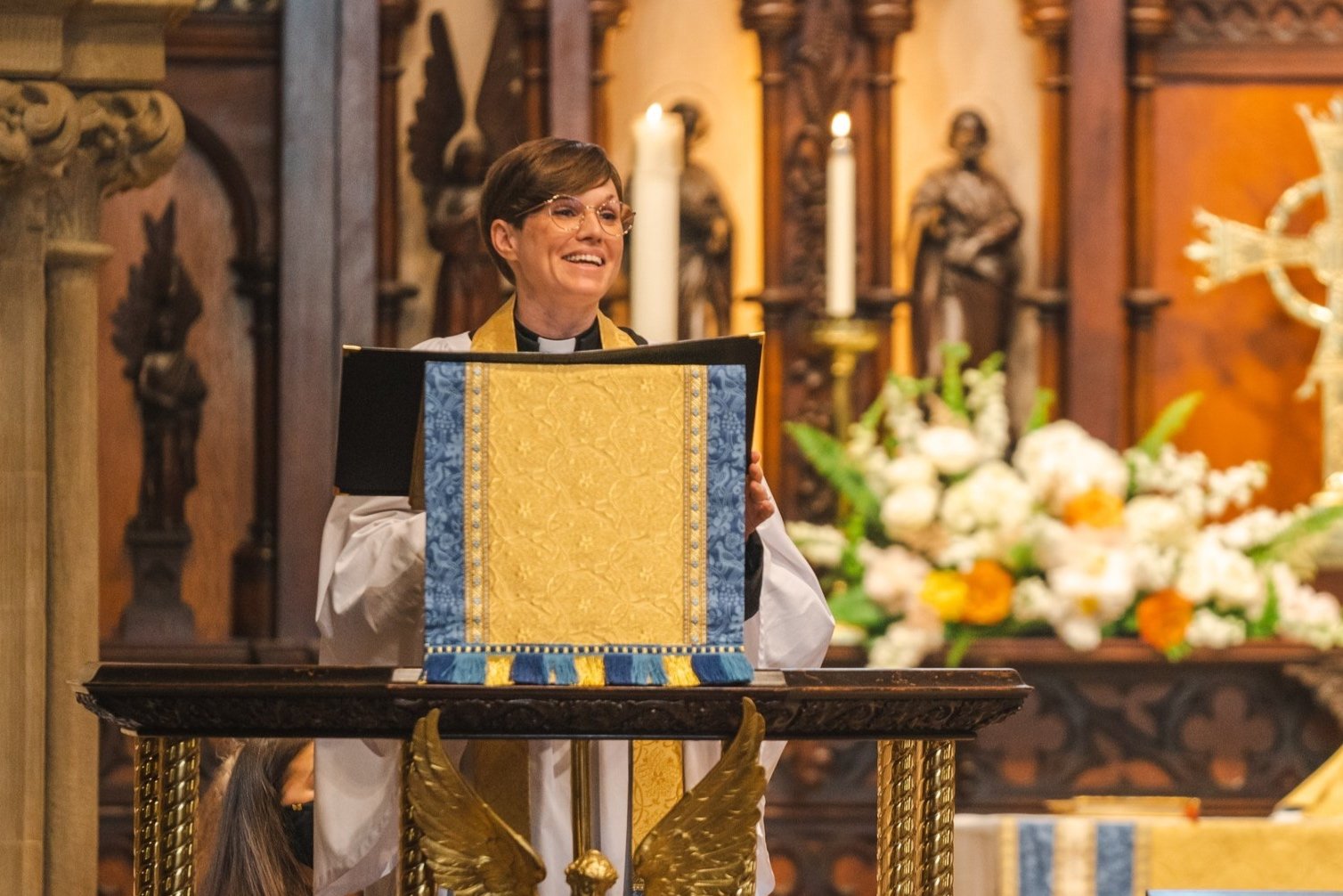
A Sermon by the Reverend Mother Crystal J. Hardin on the Second Sunday of Easter, April 12, 2026.
John 20:19-21
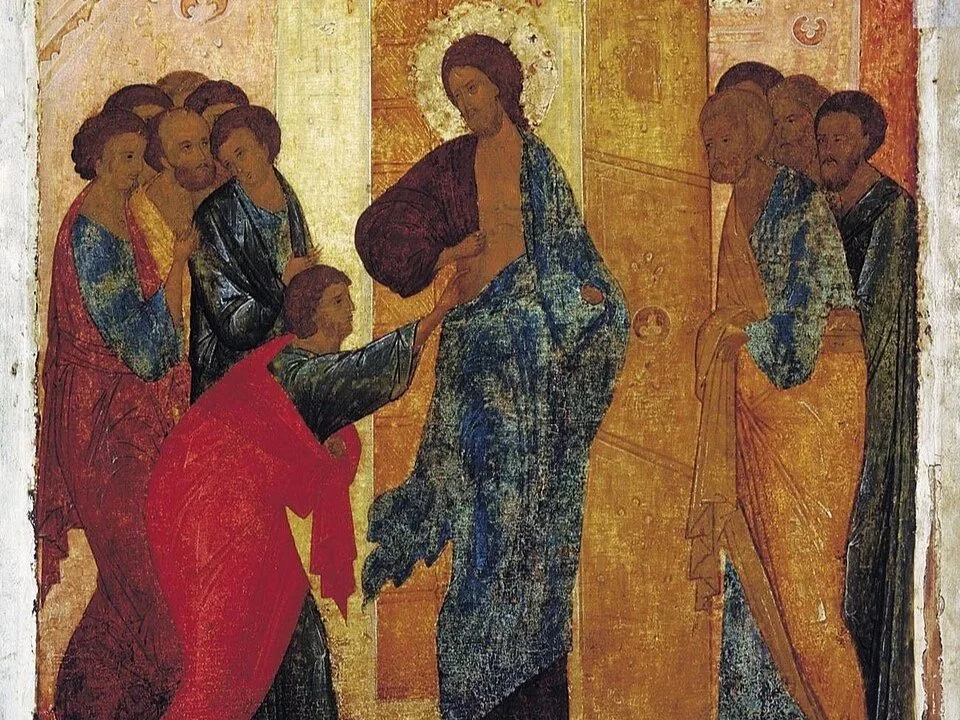
But Thomas (who was called the Twin), one of the twelve, was not with them when Jesus came. So the other disciples told him, "We have seen the Lord.” But he said to them, "Unless I see the mark of the nails in his hands, and put my finger in the mark of the nails and my hand in his side, I will not believe.” (John 20:25)
This Sunday in the church year has long been known as Low Sunday, which I confess I once took to be a rather impolite but accurate description of the Sunday after Easter. For years, I assumed low Sunday was just the church’s way of saying, “Well, the crowd sure was bigger last week.”
But, as it turns out, low Sunday is a genuine liturgical designation. Not low as in lacking —for faith, joy, energy or even robust attendance —but low in contrast to the High feast of Easter Day. It is still part of Easter, the octave day, but in a quieter key.
In the ancient church, it was also the day when those baptized at the Easter Vigil first laid aside their white baptismal robes, concluding the church’s ancient custom of keeping the newly baptized clothed in white throughout Easter Week —which suggests that Christians had opinions about when to stop wearing white long before Southern women handed down the Labor Day commandment.
So, this Sunday has long belonged to those learning what resurrection feels like after the lilies start drooping and the brass quiets down —those learning how to wear Easter not just for a day, or a season, but for a life.
It carries both the brightness of Easter and the tenderness of what comes after —when the alleluias settle in and resurrection has to find us not only in glory, but in the ordinary too.
A week ago we stood in the blaze of Easter and proclaimed that Christ is risen, triumphant over sin and death. And yet today the graves of those we love are still not empty. The news of the past week does not suggest that sin has been vanquished from the earth -quite the opposite honestly. Our own hearts, our own homes, our own lives offer ample evidence that sorrow, guilt, fear, and chaos did not simply evaporate because the church said Alleluia last Sunday.
For many of us, there is a gap between the joy of Easter and the reality of life as we experience it. A gap between what we proclaim and what we can yet perceive. A gap between resurrection and a world that still looks terribly unfinished. Sometimes that gap feels wide enough to swallow us and our fragile faith whole.
And John, to his credit, does not ignore that gap. He writes for people like us: people trying to believe that Jesus has risen from the dead, and trying just as hard to believe that this changes anything at all. John writes, he says, so that we may come to believe — and believing, have life in Jesus’ name.
And it is Thomas who John places front and center.
Now, there are some saints in Scripture who seem to arrive with a single trait attached to them, as if the church, in all her efficiency, has decided that one adjective will do.
Peter, impulsive.
Mary, faithful.
Paul, intense.
And Thomas, poor Thomas, is doubting.
It is tidy. It is memorable. It is also unfair.
Because it is Thomas in today’s Gospel who so flagrantly calls attention to the gap between the good news we proclaim and the sorrow we still know. Not because he is cynical, but because he is heartbroken. Because he knows too well what happened on Friday. He was there! He has seen death do what death does. And he was not there when Jesus first came and stood among them in that locked room, breathing peace into their fear.
Still reeling from what he has seen and suffered, Thomas does not trust what his friends tell him that they have seen. He sets instead the conditions under which he could be brought to belief: Unless I see the mark of the nails in his hands, and put my finger in the mark of the nails and my hand in his side, I will not believe.
Thomas only seems to want what the others have already received: concrete proof that something has occurred. That Jesus is no longer in the tomb. That He is really Risen. And who can fault the guy for that? It seems quite reasonable to me. Frankly I might worry more about him if he had accepted all of this without protest.
And John agrees with me that Thomas is more than just “the doubter.” In fact, he gives Thomas another name. He calls Thomas the Twin.
Three times he does this: Thomas, called the twin. Thomas, called Didymus (twin). Thomas, called the twin.
Maybe Thomas had a literal twin somewhere offstage, unnamed and unremembered. We don’t know. And, frankly, this biological detail doesn’t seem of much consequence to us now. Maybe he did. Maybe he didn’t. But what if, instead, John refers to Thomas as the Twin because he is our twin. The twin of every disciple. The one in whom we see and recognize ourselves.
Poet Denise Levertov was born in England to a Welsh mother and a Russian Hasidic father. She converted to Christianity in later life, publishing a little book of poetry called The Stream and the Sapphire that traces her slow conversation to the Christian faith. In this collection is an extraordinary poem about Thomas, where Thomas’ twin is not a sibling by birth but the desperate father in Mark’s Gospel whose child is suffering terribly and who cries out to Jesus, “I believe, help my unbelief.” Thomas hears that man and knows him as kin. Knows him as his twin. Not because they share a face, but because they share a condition.
The poem begins:
In the hot street at noon I saw him
a small man
gray but vivid, standing forth
beyond the crowd’s buzzing
holding in desperate grip his shaking
teeth-gnashing son,
and thought him my brother.
I heard him cry out, weeping, and speak
those words,
Lord, I believe, help thou
mine unbelief,
and knew him
my twin.
Thomas recognizes in this man something deeply true about his own condition: what it is to be knotted up inside. To want desperately to trust; to want nothing more than to surrender. And yet to find that when Easter beckons, to feel oneself pull tight against it.
And that, I think, is why Thomas matters so much. Because he embodies that deeply human capacity to hope and to brace for disappointment. To say, “Yes, Lord, I trust you,” and to whisper in the next breath, “But what if I’m wrong.” To fling ourselves toward God and, at the same time, to tighten around some tender part of ourselves, lest it all fall apart.
Thomas is our twin because Thomas tells the truth about the heart when it is all knotted up inside. And John’s Gospel tells the truth about Thomas from the start. This is not the only time Thomas speaks. He is not dragged onto the stage in chapter twenty for one bad moment and then dismissed. No, John has been quietly drawing him for us all along.
In chapter eleven, when Jesus decides to go to Judea after Lazarus has died, when everyone knows the danger, Thomas says, “Let us also go, that we may die with him.” Which is not the speech of a coward. It is brave, loyal, and maybe a little dramatic, but brave nonetheless.
Then in chapter fourteen, when Jesus says he is going where the disciples know the way, Thomas interrupts with plain honesty: “Lord, we do not know where you are going. How can we know the way?”
Again: not pious performance. Not pretending. Just the truth.
And now here in chapter twenty, after the crucifixion, after Golgotha, after the nails and spear and burial and terror, Thomas is absent when Jesus first appears to the others. We are not told why. We are only told that he was not there. And when the others say, “We have seen the Lord,” Thomas answers with that famous refusal: unless I see, unless I touch, I will not believe.
Which sounds harsh until we remember what Thomas has seen already.
He has seen Jesus die.
He has seen hope crucified.
He has seen the world do what the world too often does: wound, torture, mock, and kill.
And so Thomas does not want a vague reassurance. He does not want optimism. He does not want spiritual spin. Thomas wants the risen Jesus to be the crucified Jesus. He wants resurrection to be real enough to include the wounds. He wants a hope sturdy enough to bear the weight of what he knows to be true.
This is not unbelief as cynicism, but unbelief as belief pulled tight by grief and fear.
There are seasons when faith comes easily, or at least more easily. The lilies are out. The alleluias are loud. The church is full. The light catches just so. We can say, “Christ is risen,” and it feels not just true but obvious.
And then there are other seasons. Seasons when the body fails, prayers go unanswered, children suffer, marriages fail, the news is too much, and grief settles into the furniture like a guest who will just not get the hint and leave already. As Levertov’s poem continues, Thomas asks:
Why,
why has this child lost his childhood in suffering,
why is this child who will soon be a man
tormented, torn, twisted?
Why is he cruelly punished
who has done nothing except be born?
The twin of my birth
was not so close
as that man I heard
say what my heart
sighed with each beat, my breath silently
cried in and out,
in and out.
And in such seasons, the old cry rises again: “I believe, help my unbelief.”
Not one or the other.
But both.
The father in Mark chapter 9 is Thomas’ twin because he is our twin too. He is the one who speaks aloud the hard, tangled sentence most of us are trying very hard not to say in public. I believe, help my unbelief. Lord, something in me reaches for you, and something in me still recoils. Something in me trusts, and something in me cannot stop counting the nails.
And this is where Thomas can help us most. Thomas refuses to pretend that faith means the disappearance of every question, every wound, every hesitation. He knows the heart does not unknot all at once. He stands before us as a disciple in whom love and uncertainty coexist, as they so often do in us
And Jesus does not shame him for it but instead returns for him. He walks right through locked doors and hard hearts, saying Peace be with you.
Then he offers Thomas exactly what Thomas asked for, not because Thomas deserved it, but because Jesus is merciful. And as the old hymn goes, there is a wideness in God’s mercy that can cover any gap.
I have often thought that Thomas’s real miracle is not that he doubted, but that he stayed. Somehow, even after missing Jesus the first time, even after refusing the testimony of his friends, Thomas is still with the disciples a week later. Still in the room. Still in the community. Still holding on, even if only by a fraying thread, long enough for grace to find him.
Thomas is not standing outside the Easter story. He is standing exactly where so many of us stand —caught between proclamation and lived experience, between hope and heartbreak, between what the church dares to shout and what the world still works so hard to deny.
Some of the most faithful people I know are not the ones who never question. They are the ones who, with all kinds of questions, keep showing up. Keep praying the prayers when they feel thin. Keep kneeling when they are not sure what they feel. Keep returning, like Thomas, to the place where Christ’s people are gathered, hoping that one day what they know in fragments will be gathered into something whole.
It is fitting that we read this story on the same day that, traditionally, those baptized at the Easter Vigil first laid aside their white baptismal robes. Because, in Baptism, we do not promise that every question will be resolved. We do not renounce evil and then rise from the font as creatures of pure certainty. We rise as a people claimed by God and marked as Christ’s own forevermore — well before the knots in us have begun to loosen.
Which means that even the Thomas within us belongs to Christ. Even the parts of us drawn tight with fear, grief, and longing.
The brave Thomas.
The bewildered Thomas.
The loyal Thomas.
The wounded Thomas.
The Thomas who wants to believe and the Thomas who cannot yet get there from here.
And when Christ comes near to that Thomas — not the polished Thomas, not the certain Thomas, but the actual Thomas — what rises from him is not apology, not embarrassment, but one of the clearest confessions in all Scripture: My Lord and my God.
And Levertov’s poem helps us hear what is happening in that moment. Thomas is not humiliated by Jesus. He is not shamed for his questions. He is not crushed by finally being proved wrong. He is illumined. Unbound. Brought forth. As she writes:
But when my hand
led by His hand’s firm clasp
entered the unhealed wound,
my fingers encountering
rib-bone and pulsing heat,
what I felt was not
scalding pain, shame for my
obstinate need,
but light, light streaming
into me, over me, filling the room
as I had lived till then
in a cold cave, and now
coming forth for the first time,
the knot that bound me unravelling,
I witnessed
all things quicken to color, to form,
my question
not answered but given
its part
in a vast unfolding design lit
by a risen sun.
That is Thomas’s gift to the church. Not certainty without wounds. Not faith without questions. But the witness that what is knotted in us may, in the hand of Christ, begin to loosen and be gathered into something larger than we can yet see.
Not at the height of Easter morning, but here, in Easter’s second breath.
Amen.