Whose Image Do You Bear? | A Sermon on Baptism, Grace, and God
A Sermon by the Reverend Mother Crystal Hardin for the Twenty-First Sunday after Pentecost, October 18, 2026.
Exodus 33:12–23; Matthew 22:15–22
As many of you know, I am a pretty avid reader, usually fiction, occasionally theology, poetry or short essays. But every now and again, I branch out.
A few years ago, I went on something of a reading binge about how to have difficult conversations. I was desperately trying to stay in relationship with those around me in rocky times, most especially my family and in-laws back home in Alabama. And about more than just politics, although what is politics really but literally everything.
I'll be honest, at some point, all of this research became another way to avoid the difficult conversations I knew I needed to be having, so I'm not sure I'd call any of it a success.
I'll also admit that one of the online articles I remember best is called Understanding Etiquette: Talking Politics and Religion, by, wait for it, The Modern Day Man. Which I found, incidentally, when looking for information not on the topic at all, but on whiskey.
According to the Modern Day Man, when discussing things normally considered conversational taboo—like religion, politics, and money—one should follow these six guideposts: gently does it, time and place, it's not a debate, don't make assumptions, cool, calm, and collected, and have an escape plan.
So, let's see how we do.
This is a sermon about religion, politics, and money. Not particularly gentle, but at least it wasn't my opening line.
We're in church on a Sunday morning, which seems like as good a time and place as any. And I suppose the fact that we're Episcopalians takes care of remaining cool, calm, and collected. At least visibly.
As for an escape plan, I'll execute on that in about ten minutes. (Okay, maybe twelve, but who's counting?!)
—
Religion. Politics. Money.
Three subjects that polite society has long advised us to avoid in conversation, especially with people whose opinions may differ from our own.
Which is a little unfortunate, given how much of the Gospel is concerned with precisely these things. And today's Gospel is no exception.
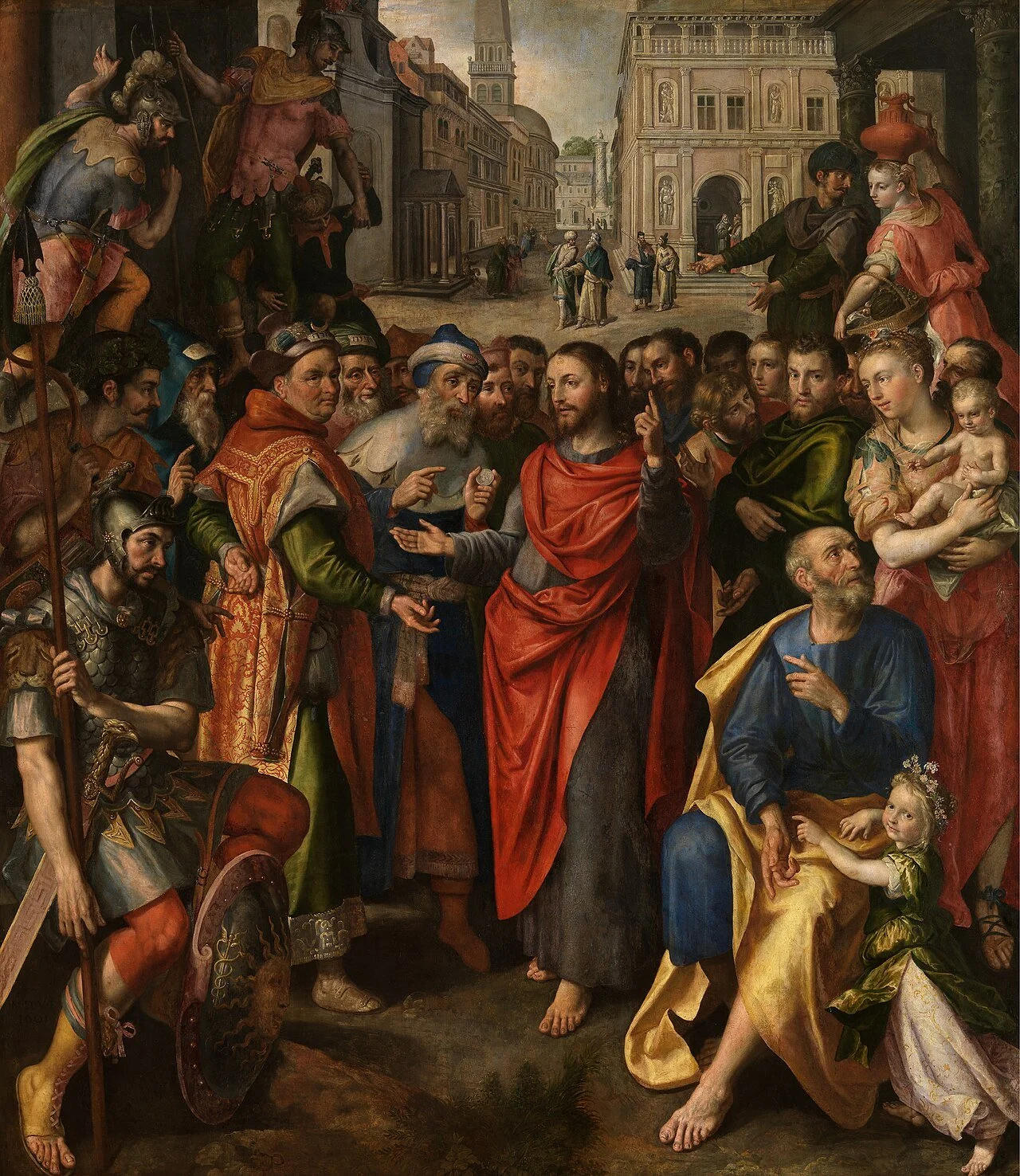
Give therefore to the emperor the things that are the emperor's, and to God the things that are God's (Matthew 22:21).
This is Jesus' response to a question about taxation.
The Pharisees and the Herodians approach Jesus during what will be his last week in Jerusalem and, after flattering him a bit, ask whether it is lawful to pay taxes to Caesar.
Except they aren't really interested in Jesus’ answer—which, by the way, is not a particularly good place to start if you're trying to have a difficult conversation.
They are trying to trap him. Their intent is malicious.
The Pharisees and Herodians had different relationships to Roman power, and the question of taxation was fraught with political and religious implications.
To refuse the tax risked confrontation with Rome. To pay it raised uncomfortable questions about allegiance to an emperor whose authority was presented in divine terms.
The choice they present is between idolatry and insurrection.
And Jesus, as Jesus is wont to do, refuses to accept the terms of the question. He asks them instead to show him the coin used to pay the tax.
“Whose head is this, and whose title?”
“The emperor’s,” they answer.
And Jesus replies: Give therefore to the emperor the things that are the emperor's, and to God the things that are God's.
Or, more famously, in the King James: Render therefore unto Caesar the things which are Caesar's; and unto God the things that are God's.
Jesus isn't interested in the choices presented by the world. Or rather, he isn't limited by them. There is no simple yes or no here. Instead, he turns the question around.
The coin belongs to the emperor. His face is stamped right on it. Let him have it, Jesus seems to say.
But this begs the question: What belongs to God?
—
From the opening chapters of Genesis, we know that as human beings created by God, we bear God’s image.
The image and likeness of God are stamped into us and upon us, written across our very beings. Which means that if Caesar can claim the coin because it bears his image, then God can claim us because we bear God's image.
Not just some part of us. Not just our Sunday mornings or our religious inclinations or the occasional prayer offered in times of desperation.
Our whole and entire selves.
That is the thing, isn't it?
Everything belongs to God. Creator, Sustainer, Redeemer.
The very idea that something belongs to us, or to the State, and not ultimately to God is ridiculous. And yet, we are awfully good at behaving as if our lives can be divided into neat little compartments.
Here are the things that belong to God: our worship, our prayers, our Sunday mornings, our good deeds.
And here are the things that belong to us: our careers, our relationships, our money, our politics, our time.
Now, we might even imagine that what Jesus is doing here is drawing precisely that kind of distinction. That Caesar can have our political and financial lives, while God is content to have our religious ones.
But that interpretation rather misses the point. Because everything bears some relationship to God.
The question is not how much of our lives God gets.
The question is whether we recognize to whom our lives belong in the first place.
—
In our reading from Exodus this morning, Moses is engaged in a difficult conversation of his own.
God has called Moses to lead the people of Israel through the wilderness, away from slavery and toward the land promised to them. But Moses has questions. He has concerns.
And, as anyone who has spent much time with Moses knows, he is not particularly shy about bringing them to God.
“See,” Moses says, “you have said to me, ‘Bring up this people’; but you have not let me know whom you will send with me” (Exodus 33:12).
In other words, God, you've given me this enormous responsibility, but I'd appreciate a little more information about how you expect me to accomplish it. And God's response is extraordinary.
“My presence will go with you, and I will give you rest” (Exodus 33:14).
Not a map. Not a detailed strategic plan. Not even an assurance that the road ahead will be easy. No, God promises God’s very presence, which is everything.
And Moses, still not entirely satisfied, presses further: “Show me your glory, I pray” (Exodus 33:18).
It is an astonishing request. At its best it speaks to Moses’ desire to see God. To know God. To experience the fullness of the One who has called him. And not just himself; because there is a wonderful detail in Moses’ response to God’s promise. He insists that God’s presence must accompany all the people, not just Moses himself.
And while God grants him only a glimpse of divine glory, there is something God has already given Moses that is perhaps even more remarkable.
“I know you by name” (Exodus 33:17).
Before Moses knows how the future will unfold, before he can be certain of anything that lies ahead, God knows him. And God promises to go with him and the people entrusted to his care. God’s promise is not simply individual assurance, but a promise that creates, sustains, and accompanies a community.
And this is remarkable, because remember where we are in the story. Just last week, we heard about the golden calf, the people of Israel turning away from the very God who had delivered them from slavery. And now, in the aftermath of that betrayal, God promises to go with them.
Not because they have been faithful.
But because God is.
And perhaps this is where our two readings meet.
In Matthew, Jesus draws attention to the image stamped upon a coin.
In Exodus, God reminds Moses that he is known by name.
Both speak to the question of identity and belonging. And both remind us that what is most important about belonging to God is not what God can demand of us, but what God has already promised us.
—
This year, we’ve spent a great deal of time at Holy Cross talking and thinking about baptism.
We’ve talked about our beautiful new font, about its design and the care that went into creating it, and about what this sacred vessel means for our common life.
In our Children’s Newcomer and Communion Enrichment classes these past few weeks, we explored the relationship between the font, the Liturgy of the Word, and the Table. And I had the wonderful opportunity to explore with our children the expansiveness of God’s love, the extraordinary generosity of a God who makes room for us, who knows us by name, and who invites us into a life of belonging.
Our children are not waiting to become part of God’s family. They are already beloved members of this community, with a place among us at God’s table.
One of them shared their excitement about their upcoming baptism, a decision they have made for themself.
And I find something particularly lovely about that, about a child choosing baptism. Not because they are seeking permission to belong, but because they are already experiencing what it means to belong and want to claim that relationship more fully.
Baptism is not the moment God decides to love us. God’s love precedes our understanding of it, our ability to articulate it, even our capacity to respond to it. But, in baptism, that love takes on a particular form. In water and word, we are joined to Christ, incorporated into Christ’s body, and marked as Christ’s own forever.
Forever.
Not until we disappoint God. Not until we fail to live up to our promises. Not until we wander off into the wilderness and lose our way.
Forever.
At the font, we proclaim that we belong to God. And this belonging is not something we have earned. It is not the reward for a life well lived or a faith perfectly practiced.
It is grace: the God whose image we bear is the God who knows us by name, who claims us in Christ, and who promises to be with us.
And yet, baptism is not simply an assurance that we belong to God. It is also a calling to live as though that were true.
Which turns out to be a rather radical proposition. Because it means that no other claim upon our lives can ever be ultimate. Not the claims of our political parties or our national identities. Not the claims of our careers, our possessions, our reputations, or our carefully constructed ideas about who we are supposed to be.
These things may matter a great deal. Some may be good and necessary. Some may even be holy. But none can tell us, finally, who we are.
God has already done that.
And if that is true for us, then surely it must also be true for everyone else.
Consider what this means for the world in which we live.
A world in which we are constantly being asked to declare our allegiances, to establish our identities in relation to one group or another, to decide who belongs and who does not.
Our politics, our money, our status, our education, the neighborhoods in which we live, the people with whom we associate—all of these can become ways of sorting ourselves and one another.
And sorting, as it turns out, is considerably easier than loving.
Because loving requires us to recognize something about the person standing across from us that may be terribly inconvenient.
That they, too, bear the image of God. That their life, like ours, belongs to God.
That before we knew anything about them—their politics, their beliefs, their failures, their accomplishments—they were already known to the One who created them.
And this is not simply a call to be polite, to tolerate our differences, or to agree to disagree.
It is a claim on how we live together. How we exercise power. How we pursue justice. How we treat those who are vulnerable, those who are strangers, and those with whom we profoundly disagree.
Now, hear me when I say that this does not mean that our differences are unimportant, or that our political choices have no moral consequences. Quite the opposite.
Because if every human being bears the image of God, then no political system, no economic arrangement, no claim of national security or public order can make that image disappear.
We may disagree about what justice requires. We may disagree about the means by which it should be pursued. But we cannot, as Christians, disagree about whose image is borne by the people impacted by our choices.
Because there is no part of our lives that falls outside our relationship with God. And there is no person we encounter who falls outside God's concern.
—
And so friends, Jesus does not give us a tidy division between the things that belong to Caesar and the things that belong to God.
He gives us something far more unsettling.
A reminder that everything belongs to God. And everything includes us.
We come to the font to remember whose we are.
We come to the table to receive what we could never earn.
And we go into the world to recognize in one another the image of the God who has claimed us all.
And sometimes the person standing across from us is someone we’ve known all our lives. Someone we love and who has loved us. Someone with whom we can barely imagine having another difficult conversation. And yet, the thought of never speaking to them is its own kind of grief.
Caesar may have his coin.
But you, beloved, bear the image of God.
Remember whose image you bear.
Remember to whom you belong.
Especially when you find it difficult to remember that the person standing across from you bears the image of God, too.
Amen.
Image courtesy of Wikicommons, “Render unto Caesar” by Marten de Vos (1602).